Why is it called Mui Ne? The name points to a coastal headland and a fishing community older than the resort strip. Old maps use different spellings, while a familiar explanation connects the cape with boats sheltering from wind. Here is what the historical sources show, and what remains uncertain.
Quick Answer: Mũi means a cape or headland. A common explanation links Né to boats taking shelter from wind, but the precise origin of the full name is not certain. Historical spellings such as Vị Nê and Mũi Nê appear in local research based on old maps and records. The area developed as a fishing settlement long before it became a holiday destination.
What does the name Mui Ne mean?
The first part is straightforward: mũi describes land projecting into the sea. The familiar story says fishermen brought their boats behind this cape to avoid strong wind and rough water, giving rise to the idea of “sheltering” or “dodging.” The geography makes that explanation easy to understand, but it should be presented as an interpretation rather than a proven word-for-word translation.
Local historian Phan Chính, writing about Bình Thuận place names, points to several older forms. His discussion cites Vị Nê Sơn on the 1838 Taberd map, as well as Hán-Nôm forms referring to a cove or headland, later Mũi Nê, and the French spelling Muiné. Those variations show that the name changed in writing across languages and periods. They do not tell us the exact day someone first called the place “Mui Ne.”
A fishing community older than the resort coast
Mui Ne did not begin with tourism in the 1990s. Another account by Phan Chính cites the historical gazetteer Đại Nam nhất thống chí, which mentions a Nam Hai shrine near Vi Ne hill and Thạch Long village. The account associates the shrine with a visit by Nguyễn Ánh in 1795, before he became Emperor Gia Long. This is evidence of an established coastal community by the late eighteenth century; it is not a reliable founding date for the village.
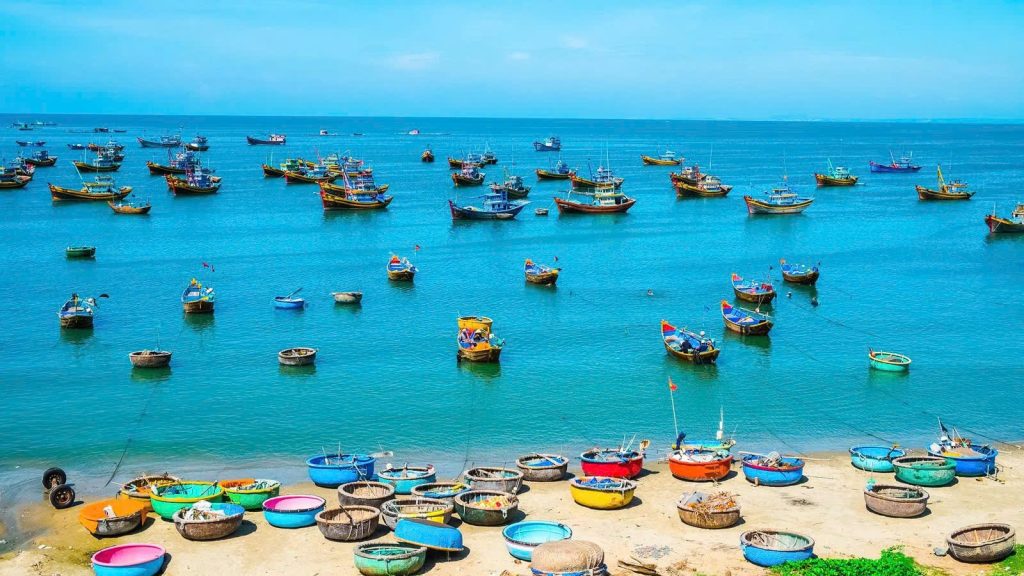
For generations, fishing, boats, seafood trading and the rhythm of the sea shaped daily life here. The bay is still a workplace. When you see round basket boats and larger vessels at the Mui Ne Fishing Village, you are looking at a living part of the place, rather than an attraction created for visitors. Activity depends on weather, catches and the hour of the day, so no particular scene can be guaranteed.
From the old headland to the Mui Ne visitors know
Today, travellers often use “Mui Ne” for a much wider holiday area, including the resort coast around Ham Tien and the roads toward the dunes. That tourist usage is broader than the old place-name story. The fishing settlement and sheltered cape explain one part of the destination; the White Sand Dunes, Red Sand Dunes and beaches explain why many people visit now.
For a useful half-day view, begin with the landscapes and include the village stop on a standard Jeep route. A 04:30 sunrise departure gives the best chance of seeing a busier morning shore, although fishing work varies. The 14:00 afternoon trip still gives a view over the boats and coast. If you want to spend a long time talking with residents or researching historic sites, arrange that separately; the standard village stop is a brief sightseeing visit, not a specialist history tour.
How to visit respectfully
- Stay clear of people unloading fish, moving carts or preparing boats.
- Ask before photographing anyone closely, and keep children away from active work areas.
- Wear footwear suitable for a working shoreline; surfaces can be wet or uneven.
- Use the coastal-road guide to understand how the village fits with other viewpoints.
Common questions about Mui Ne’s name
Was Mui Ne named after a resort?
No. Historical place-name forms and the older fishing settlement precede the modern resort industry by a long time.
Is the “boats hiding from storms” story a proven origin?
It is a sensible and widely repeated explanation tied to the shape of the coast. Older spellings mean we cannot present it as a conclusively established linguistic origin.
Historical sources: Phan Chính on old Bình Thuận place names; his account of the Vi Ne/Thạch Long record; Vietnam Tourism on the fishing village today.

See Mui Ne Beyond Its Name
Visit the Fishing Village, dunes and Fairy Stream on a local Jeep route. Shared $8/person; Private $30/Jeep for 1–6. Depart at 04:30 or 14:00; Private Flexible departures 07:00–16:00 by confirmation. Free pickup in Ham Tien and Mui Ne; outside locations need confirmation. No deposit; pay on the tour day. Book Private Flexible at least three hours before pickup. For fixed tours, reserve sunrise by 20:00 the previous day or sunset by 10:00 on the day.